Showing posts with label rainforest. Show all posts
Showing posts with label rainforest. Show all posts
The Cassowary Tales


The Cassowary is a flightless bird, found in Australian Rainforests. This huge bird is the most dangerous bird on earth, mostly because of his powerfull legs and spike-like toe, always ready for defending himself and offspring.
The unique feature is the helmet (casque): Grey in colour and slightly directed forward this vertical bony helmet protects the birds head as it makes its swift way through the thick undergrowth of the rainforest. The Cassowary is the only bird in the world to have any type of protective armour.
Much of Australian rainforest has now been cleared, and the Cassowary that remain are vulnerable to dogs, shooting, traffic when crossing roads, starvation and, possibly, disease (Tuberculosis and aspergillosis-related diseases) and nest predation and competition from feral Pigs. The main reason for decline in the southern Cassowary population has been clearance of the prime habitat, rainforests. Clearance for agriculture has virtually ceased but continues for residential and tourist development. Adult Cassowaries are occasionally shot, though this is illegal.
This guy in the picture is a lucky one! Plenty of food and attention, permanent health care, and luckiest thing of all: he lives in the wonderful city of Sydney
;-) .
Protect us from ourselves
 UN Urges Protection of Animals from Climate Change
June 04, 2007 — By Anna Mudeva, Reuters
THE HAGUE -- A senior United Nations official urged a 171-nation U.N. wildlife forum on Sunday to take action to help protect animals from climate change.
The Convention on International Trade in Endangered Species (CITES) will also discuss measures at its two week-week meeting to help commercially valuable animal and tree species threatened by over-use.
A U.N. report has said human activities were wiping out three animal or plant species every hour and has urged the world to do more to slow the worst spate of extinctions since the dinosaurs by 2010.
Global warming, blamed mainly on human use of fossil fuels, is widely expected to add to existing threats and wreck habitats like the Amazon rain forest.
"CITES is not a forum for discussing climate change but decisions taken here do have an impact on species in a climatically challenged world," Shafgat Kakaklhel, deputy head of the U.N. Environment Programme, told the opening session.
"We will need robust species populations if they are to survive rising temperatures and more extremes," he said.
RAPID DEPLETION
Many of the 37 proposals to be discussed at the meeting in The Hague reflect growing concern about rapid depletion of marine and forest resources.
Commercially valuable species like the spiny dogfish, the porbeagle shark and the European eel -- all threatened by over-use -- feature high on the agenda.
The focus will also be on coral jewellery, wooden musical instruments and furniture. Threatened species like pink or red coral and rosewood and cedar trees are facing tighter trade regulations.
Elephants are expected to trigger heated debate. African countries are split over the protection of the elephant, with some saying elephant populations have grown at an unsustainable rate.
CITES is widely credited with stemming the slaughter of the African elephant by imposing a ban on the international ivory trade in 1989.
But scientists say the killing of elephants for their tusks, mainly in central Africa, has reached levels not seen since 1989 because of Asian-run crime syndicates.
The talks will also help shape the future of CITES, which has banned trade in 530 animal species and more than 300 plant species.
CITES also regulates trade in 4,460 animal species and 28,000 plant species.
Source: Reuters
THE HAGUE -- A senior United Nations official urged a 171-nation U.N. wildlife forum on Sunday to take action to help protect animals from climate change.
The Convention on International Trade in Endangered Species (CITES) will also discuss measures at its two week-week meeting to help commercially valuable animal and tree species threatened by over-use.
A U.N. report has said human activities were wiping out three animal or plant species every hour and has urged the world to do more to slow the worst spate of extinctions since the dinosaurs by 2010.
Global warming, blamed mainly on human use of fossil fuels, is widely expected to add to existing threats and wreck habitats like the Amazon rain forest.
"CITES is not a forum for discussing climate change but decisions taken here do have an impact on species in a climatically challenged world," Shafgat Kakaklhel, deputy head of the U.N. Environment Programme, told the opening session.
"We will need robust species populations if they are to survive rising temperatures and more extremes," he said.
RAPID DEPLETION
Many of the 37 proposals to be discussed at the meeting in The Hague reflect growing concern about rapid depletion of marine and forest resources.
Commercially valuable species like the spiny dogfish, the porbeagle shark and the European eel -- all threatened by over-use -- feature high on the agenda.
The focus will also be on coral jewellery, wooden musical instruments and furniture. Threatened species like pink or red coral and rosewood and cedar trees are facing tighter trade regulations.
Elephants are expected to trigger heated debate. African countries are split over the protection of the elephant, with some saying elephant populations have grown at an unsustainable rate.
CITES is widely credited with stemming the slaughter of the African elephant by imposing a ban on the international ivory trade in 1989.
But scientists say the killing of elephants for their tusks, mainly in central Africa, has reached levels not seen since 1989 because of Asian-run crime syndicates.
The talks will also help shape the future of CITES, which has banned trade in 530 animal species and more than 300 plant species.
CITES also regulates trade in 4,460 animal species and 28,000 plant species.
Source: Reuters
Up in Flames


An animal rescue team in Indonesia treated more than 40 orangutans for respiratory problems and burns toward the end of 2006 following fires that drove them from their forest home. More.
When will WE start thinking ahead and not only for now?
dfgadfgadfgadfg
Items to avoid and protect the rainforest, be aware of them here.
Dear Rainforest
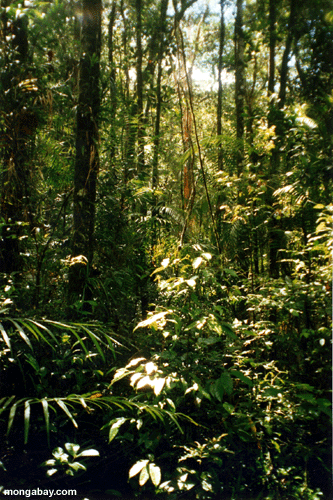
"Rainforests make rain and rain makes rainforests"
Rainforests are our most precious O2 pump! The impact of seeing it
 (Photo thanks to Planet Ark)
Nothing beats the power of a good photograph. Reading about rainforest deforestation doesn't have the same impact as a picture of native indians walking through recently burnt rainforest.
Subscribe to:
Posts (Atom)